
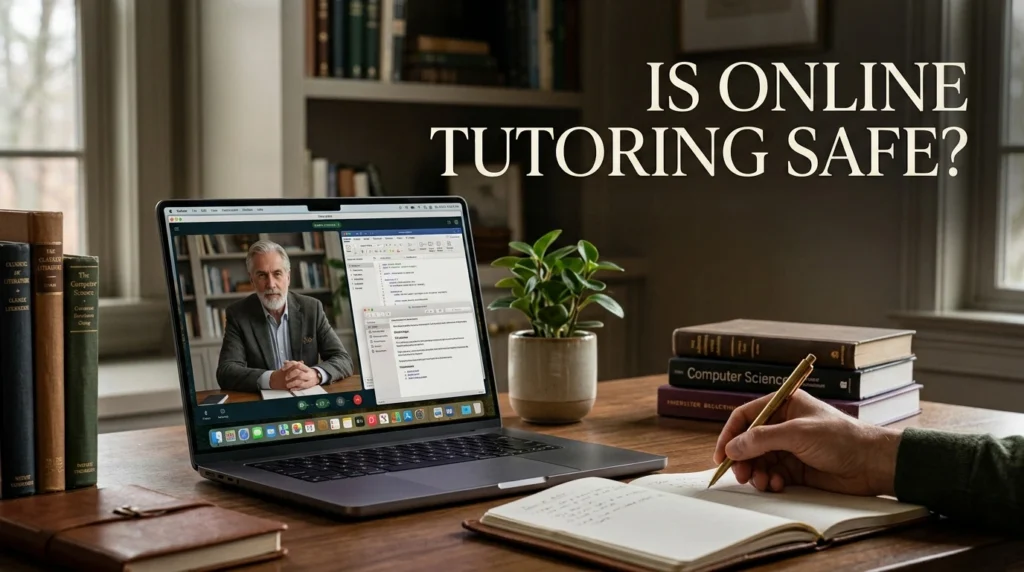
Online tutoring can be safe for children when the tutor or tutoring provider has proper safeguarding procedures, appropriate vetting, clear communication boundaries and a secure learning environment.
However, parents should not assume that every online tutor follows the same standards. Before booking lessons, it is worth checking who the tutor is, what checks have been completed and how the provider handles safeguarding concerns.
This guide explains the main safety questions UK parents should ask before choosing an online tutor.
Is Online Tutoring Safe For Children? Is It Better Than In-Person Tutoring
Yes, online tutoring can be a safe way for children to learn when sensible safeguards are in place. The safety of a session depends on the tutor, the tutoring provider, the technology being used and the arrangements agreed with parents.
Online lessons also have practical safety advantages. Your child can learn from home, you can remain nearby, and you do not need to send them to an unfamiliar location. You can also see how the lesson is delivered and how the provider communicates with families.
Whether your child is studying for an exam or taking online math classes, online tutoring is a safe choice. It can help them solve equations and learn algebra, which many children find hard.
The weak point online is contact outside of lesson hours. That is where most problems in tutoring start, and it is the easiest thing to control.
9 Safeguarding Questions to Ask Before You Book an Online Tutor
Before booking lessons ask these by email, on a call, or during a trial lesson. Ask direct questions about how the tutor or provider protects students.
1. Who Will Actually Teach My Child?
You should know the tutor’s name, subject expertise, qualifications and teaching experience before lessons begin. Avoid providers that give vague answers such as “one of our tutors” without allowing you to understand who that person is. Guru At Home’s tutor profiles for UK students include information about qualifications, teaching experience and subjects they specialize in. Reviewing the tutor before booking gives parents a clearer picture of who will be teaching their child.
2. Does the Tutor Have an Enhanced DBS Check?
Ask what type of criminal record check the tutor has and when it was completed. For a tutor working with children in the UK, that means an enhanced DBS check rather than a basic one. Ask about qualifications in the same breath, and ask what references have been taken up.
The NSPCC advises parents to confirm a tutor has been through proper vetting, including criminal record checks and full reference checks, before hiring them.
3. Can You See the Provider’s Safeguarding Policy, and Who is Responsible For It?
Ask whether the tutoring company has a written safeguarding and child protection policy. The policy should explain how concerns are reported, who is responsible for handling them and what parents should do if they are worried about an online tutor or a student’s safety.
4. Who Do You Contact If You’re Worried About a Tutor?
This is one of the most important questions for parents, you should have a clear contact for concerns who are separate from the tutor. This gives parents somewhere to go if the issue involves the tutor or if they simply do not feel comfortable raising it directly with them. Ask for the person’s role, contact details and the process for reporting a concern. A provider should also explain what happens after a complaint is made.
5. How Are Parents Kept Informed About Progress?
Parents should not be left completely outside the tutoring process. Regular updates help you understand what your child has been learning, where they need support and whether the arrangement is working — whether that is the grammar mistakes coming up in their English lessons or the questions they answered incorrectly in their last science tutoring session.
Guru At Home provides parent-focused information about its tutoring process, tutor profiles and student support.
6. Are Online Lessons Recorded, and Who Can See Them?
Ask three things: are sessions recorded, who can watch the recording, and how long it is kept. Recording is not the only form of monitoring, and it is not automatically appropriate for every provider or every lesson. What matters is whether the company has a clear process for protecting students and reviewing concerns. You should also ask how lesson links are protected.
7. How Is My Child’s Personal Data Protected?
Online tutoring can involve personal information such as your child’s name, school year, academic needs, lesson history, video and contact details. Ask what information the provider collects, why it needs it and how long it keeps it. The ICO’s Children’s Code applies to many online services likely to be accessed by children and includes standards around transparency, privacy and the protection of children’s information.
8. Can I Watch Online Lessons and Change Tutors?
The answer to both should be yes. Ask whether you are allowed to remain nearby or observe a lesson. You do not need to supervise every session, but there should not be an unnecessary barrier between parents and the learning environment. Parental visibility also helps you judge whether the tutor communicates professionally and whether your child feels comfortable asking questions. Changing tutors should be simple and free.
9. What Happens During the First Lesson?
A trial or introductory lesson gives you the chance to assess both the teaching and the professional boundaries. Watch how the tutor responds when your child gives a wrong answer. A good tutor should correct the mistake respectfully, encourage the child to try again and explain the concept without making the student feel embarrassed.
Online Tutoring Red Flags: When to Walk Away
- The provider will not name the tutor, or the name keeps changing.
- You are told you cannot sit in, or that your child “focuses better alone”.
- A tutor asks to message your child on WhatsApp, Instagram, Snapchat or a personal number.
- You are asked to pay the tutor directly, off-platform or in cash.
- There is no written safeguarding policy and no named contact for concerns.
- Vague vetting claims with nothing behind them.
- Pressure to buy a large package before you have seen a lesson.
- Open meeting links with no password or waiting room.
- Your child becomes secretive about lessons or reluctant to attend.
One of these is worth pausing over. Two or more, and look elsewhere.
Why parents trust Guru At Home
We have answered every question above for UK families, so here is our own answer.
Vetted tutors – Our tutors hold bachelor’s or master’s degrees and complete enhanced DBS checks. These are platform-wide standards, not something we apply to a handful of profiles.
Named tutors you can see first – Every tutor is listed with their qualifications and teaching experience, so you know who will teach your child before you book.
A second point of contact – Each family works with a coordinator alongside the tutor, plus support outside lesson hours, so a concern never has to go through the tutor.
Contact stays on the platform – Lessons, homework and feedback run through our system, and payments come to us, never directly to a tutor.
Open lessons and free tutor changes – Sit in on the trial and on any lesson after that. If the match is wrong, say so and we will change it.
What we do not promise – We do not guarantee grades or claim every child transforms. Progress usually shows up in behaviour first, and only later in results.
What a UK parent said
Tanya Saxena’s son Yuvaan is in Year 3 in the UK. He started one-to-one maths lessons with Miss Navtej, and three months later she left us a review and we published her son’s case study on our website. You can read the full story in our Year 3 maths case study, which sets this UK family’s review alongside the tutor’s own learning record.
Our rating from parents sits at 4.8 out of 5 across 280 Google reviews. Most of them name the tutor, so you can read what a parent in your position said about the person who would teach your child.