
Year 3 Maths Tutoring Case Study: Yuvaan's Three-Month Journey to Confident Problem Solving
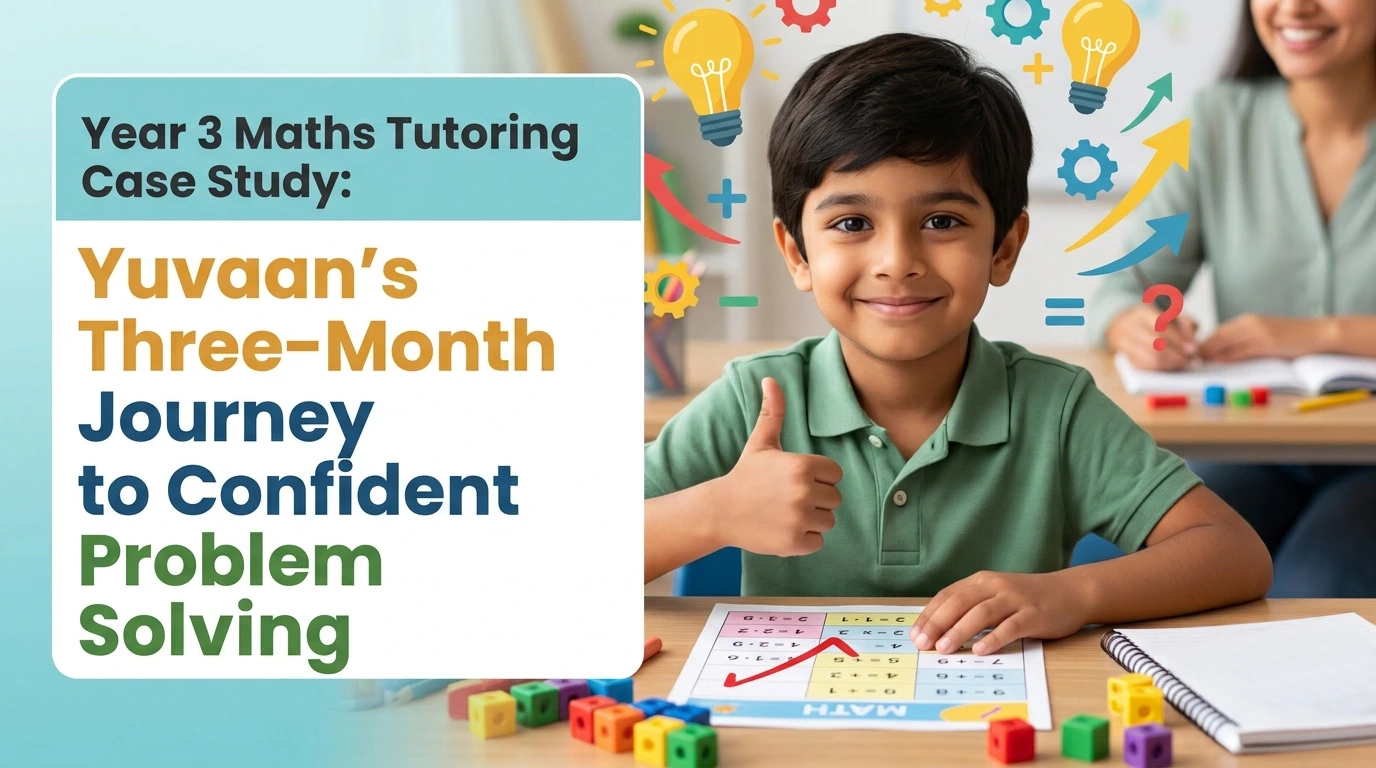
Three months of one-to-one online maths lessons. One Year 3 pupil in the United Kingdom. A clear shift from getting the answer to explaining the thinking behind it.
Pupil: Yuvaan, Year 3, United Kingdom |
CASE SNAPSHOT
Pupil | Yuvaan | Year group | Year 3 |
|---|---|---|---|
Location | United Kingdom | Subject | Maths |
Lesson format | One-to-one online | Tutor | Miss Navtej |
Parent | Tanya Saxena | Review point | After three months |
Starting focus | Strengthen the basics | Key change | Confidence |
THE RESULT
Three Months In, One Sentence Said It All
After three months of lessons, Yuvaan’s mother described the change in a few plain words: “he is able to solve problems easily”.
There is no test score behind that sentence, and no claim that every question suddenly became easy. It is a parent noticing that maths has stopped being a battle at home.
That is what this case study explains: how three months of focused one-to-one maths tutoring turned an unsteady start into a settled one. |
THE STARTING POINT
Where Yuvaan Started
The Focus Was Foundation, Not Catch-Up
Yuvaan did not arrive with a poor school report or a formal assessment behind him. His need was narrower, and far more common among Year 3 pupils. He needed stronger basics, and a clearer sense of how numbers actually work.
Miss Navtej set the direction in the opening lines of her learning record.
“At the beginning, our focus was on strengthening his basics and helping him understand how numbers work.” – Miss Navtej, tutor learning record |
That one sentence shaped everything that followed. The plan was not to push Yuvaan through harder sums. It was to make the ideas underneath the sums strong enough to carry him forward. Parents looking for similar support can explore Year 3 maths tutoring to see how Guru At Home approaches learning at this stage.
THE APPROACH
Three Things Miss Navtej Did Differently
1. She rebuilt the number foundations first
Place value, number representation and skip counting came before anything else. These topics gave Yuvaan more than a set of steps to copy. They gave him different ways to see the same number: where each digit sits, how a number can be broken apart, and how patterns repeat.
That pays off later. A child who can picture a number in two or three ways has two or three ways into an unfamiliar question.
2. She asked for the thinking, not just the answer
When lessons moved into multiplication and division, getting the method right still mattered. Miss Navtej also added another question: How did you work that out?
“Mathematics became a subject where we focused not only on getting the correct answer but also on understanding the thinking behind it.” – Miss Navtej, tutor learning record |
A correct answer shows what a child produced. An explanation shows how the child thought. In a one-to-one lesson, a dedicated year 3 tutor can teach that second thing directly. In a full classroom, it is far harder to reach.
3. She connected maths to things Yuvaan already knew
“He enjoys interactive activities and responds well when concepts are connected to real-life examples.” – Miss Navtej, tutor learning record |
This is exactly why word problems became a turning point. A word problem hides the sum inside a situation, so the child has to read the situation first.
Take a single fact: 15 ÷ 3 = 5. It can describe two very different pictures – 15 shared equally between 3 children, or how many groups of 3 you can make from 15. The calculation never changes. Real-life examples gave Yuvaan something solid to hold on to before he turned the situation back into maths.
WHAT CHANGED
What Changed Over Three Months
Miss Navtej’s record does not describe one dramatic breakthrough. It describes four smaller changes in how Yuvaan met a question, and those are the changes that last.
WHAT WE WATCHED | WHAT MISS NAVTEJ REPORTED |
|---|---|
Attempting a question | More comfortable attempting questions |
Explaining his method | More comfortable explaining his approach |
General confidence | Growing confidence – described as the most positive change |
Meeting a hard question | More willing to try instead of hesitating |
At home, in his mother’s words | “he is able to solve problems easily” |
None of these are test scores. They are behaviours. And behaviours are what carry a child into the next topic, the next year, and the next set of unfamiliar questions.
Attempt → explain → apply → keep going |
IN THE TUTOR’S WORDS
Why Confidence Was the Real Outcome
“The most positive change has been his growing confidence. He is now more willing to try challenging problems instead of hesitating, which is an important step in developing strong mathematical thinking.” – Miss Navtej, tutor learning record |
Hesitation is the quiet problem in primary maths. A child who hesitates does not produce a wrong answer. They produce no answer at all, and the learning stops there. Getting a child to start is often worth more than getting a child to be right.
THE PARENT’S VIEW
What Yuvaan’s Mother Noticed
Miss Navtej’s record shows what changed inside the lesson. Tanya Saxena’s public review shows what changed at home across the same three months.
“It’s been 3 months since my son is taking classes from guru and our experience is truly amazing he is able to solve problems easily special thanks to his tutor Mrs Navtej kaur kohli she is so dedicated towards her students her way of teaching is excellent , i highly recommend her specially…” – Tanya Saxena, public parent review, 17 April 2026 |
Two views of the same three months. One from inside the lesson, one from the kitchen table. Together they say more than either would say alone. Read more parent reviews from families whose children have worked with us.
WIDER EVIDENCE
What the Research Says About One-to-One Tuition
The Education Endowment Foundation (EEF) reports an average impact of about five months’ additional progress from one-to-one tuition. That figure is drawn from 123 studies, and the evidence is rated as moderate. The EEF also notes that results vary, and that average effects in maths are lower than in literacy. This research provides wider context for one-to-one tuition. It is not a measure of Yuvaan’s individual progress. His progress is described through his tutor’s learning record and his parent’s review. |
IS THIS RIGHT FOR YOUR CHILD?
Signs Your Year 3 Child May Need Maths Tutoring
Yuvaan’s case is useful precisely because it started from something ordinary. If any of the following sound familiar, the same kind of support may help.
- Your child reaches the right answer but cannot explain how.
- Word problems are much harder than the same sum written plainly.
- The basics – place value, times tables, sharing and grouping – still feel shaky.
- Your child hesitates, or gives up, when a question looks unfamiliar.
- Confidence drops before ability does.
None of these need a poor school report behind them. You can read more about Year 4 tutoring on our page if you’re looking for next year.
Looking for Year 3 maths support? A free demo lesson lets your child meet the tutor first, so you can judge the teaching fit before committing to regular lessons. |
ABOUT THE TUTOR
Miss Navtej and Guru At Home UK
Miss Navtej is a maths tutor with Guru At Home UK. She taught Yuvaan throughout the three-month period described here, and the learning record quoted in this case study is her own account of that teaching.
You can meet the full team of tutors on the Guru At Home UK website. Guru At Home UK states that its tutors hold bachelor’s or master’s degrees and complete enhanced DBS checks. These are platform-wide standards that apply across the service.
QUESTIONS PARENTS ASK
Frequently Asked Questions
- What is Year 3 maths tutoring?
It is one-on-one online teaching for children in Year 3, who are usually seven or eight years old. The work centres on number foundations such as place value, times tables, division and word problems. It also focuses on helping a child explain how they reached an answer.
- What was Yuvaan’s main learning need?
Yuvaan’s main need was to strengthen his mathematical foundations and develop a clearer understanding of how numbers work. He was also encouraged to explain the thinking behind an answer rather than simply produce the correct result.
- Was Yuvaan behind in maths?
The learning record does not describe him as failing or unable to do maths. This case is about strengthening foundations, reasoning and confidence.
- How long did it take to see progress?
The changes described here were reported after three months of lessons. Progress showed first in behaviour – attempting more, explaining more – before his mother described problem solving as easy.
- What teaching style worked best for Yuvaan?
Interactive activities, and concepts linked to real-life examples. Miss Navtej noted that he responded well when maths was connected to situations he already understood.
- How do online one-to-one maths lessons work for a child this age?
Lessons are live and one-to-one, so the tutor can respond to how a child is thinking rather than only marking what they wrote. A free demo lesson lets a family see the format before committing.
- Does one-to-one tutoring actually work?
The Education Endowment Foundation puts the average impact of one-to-one tuition at about five months’ additional progress. That figure comes from 123 studies, and the evidence is rated as moderate. Results still vary from child to child.
- How can we try a lesson?
Guru At Home UK offers a free demo, so your child can work with a tutor before the family commits to regular lessons.
HOW THIS CASE STUDY WAS PREPARED
First-hand sources: Miss Navtej’s supplied learning record for Yuvaan, and Tanya Saxena’s public parent review dated 17 April 2026. |