
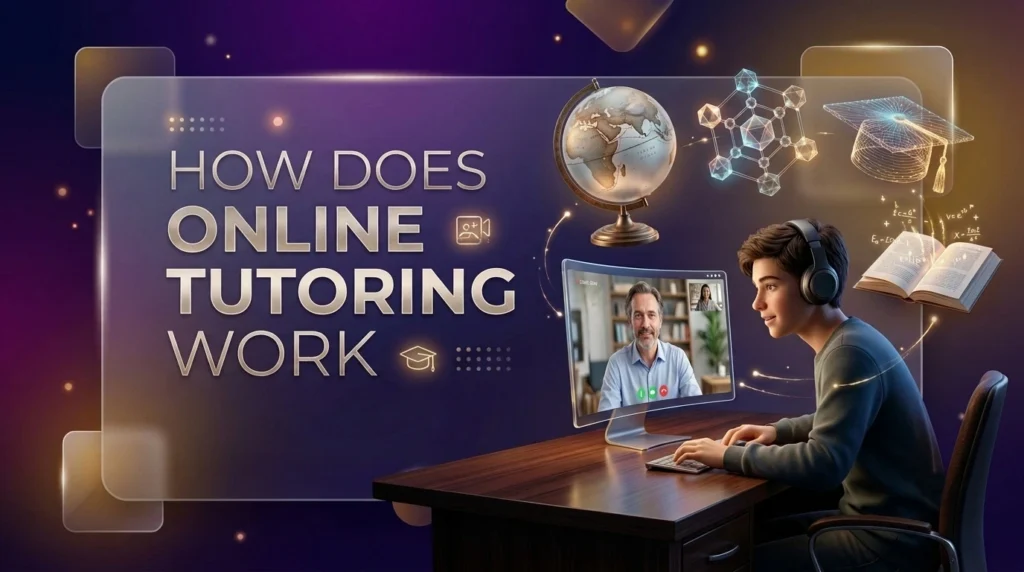
In live one-to-one online tutoring, a pupil and tutor meet in real time over video. The tutor explains concepts, asks questions, works through examples on a shared digital whiteboard, and adjusts the lesson based on what the pupil understands. Sessions are typically 45 to 60 minutes.
Online tutoring is usually much simpler than parents expect. Your child is not watching a recorded video or working through automated exercises. In live one-to-one tuition, the pupil and tutor meet online, talk through the subject, and work on questions together in real time.
Private tutoring is now common across the UK. The Sutton Trust’s 2026 polling found that 29% of secondary school pupils in England have received private tutoring at some point, up from 18% twenty years ago.
This guide explains how online tutoring works in the UK, what happens before, during and after a lesson, how to choose a tutor and what you should check before booking.
What Is Online Tutoring?
Online tutoring is live teaching delivered through the internet rather than in a classroom or at a tutor’s home. The phrase “online tutoring” covers several different types of learning, so it helps to know exactly what you are buying:
- Live one-to-one tutoring: one pupil works directly with one tutor in real time.
- Live group tuition: several pupils learn with the same tutor at the same time.
- Recorded courses: the pupil watches lessons that were prepared in advance.
- Homework or practice apps: software provides questions, explanations or exercises, sometimes with AI-generated feedback.
- Self-paced learning platforms: pupils move through materials largely on their own.
Does Online Tutoring Actually Work?
Parents are right to ask this before committing time and money. The Education Endowment Foundation, an independent charity that reviews evidence on what helps pupils learn finds that one-to-one tuition typically leads to around five additional months of progress. That is not a guarantee for any individual child; it depends on the tutoring being consistent and well-matched to what the pupil is learning at school.
A Typical Online Tutoring Lesson
Every tutor works slightly differently, but a well-run lesson tends to move through the same five stages:
1. Check in: The tutor reviews what has happened since the previous session and identifies the focus for the lesson.
2. Identify the gap: A quick question or two shows what the pupil already understands.
3. Teach and practise: The tutor explains the concept and works through examples with the pupil.
4. Apply Immediately: The pupil attempts a similar task with less support to demonstrate whether they can use the method themselves.
5. Review and plan: The tutor summarises the key learning and identifies what should happen next.
What a lesson actually looks like depends on the subject and the stage your child is working at. A GCSE maths lesson may involve past-paper questions, while a primary English session could focus on reading comprehension, spelling or writing.
Before the First Lesson: What Does Your Child Need for Online Tutoring?
The equipment required is usually straightforward. Most children need:
- A laptop, desktop computer or tablet
- A stable internet connection
- A working microphone and speakers or headset
- A webcam if video is required
- A quiet place to study
- A notebook and pen for written work
A larger screen is generally more practical than a smartphone because pupils need to read questions, view shared material and interact with the digital workspace. You may also want your child to have their recent schoolwork, homework, marked tests or revision materials nearby. These give the tutor useful context and can help connect the lesson with what the pupil is currently studying at school.
We match pupils with a tutor for primary, secondary, GCSE or A-level study based on this context, so the first session already has somewhere useful to start.
Useful next reads: meet our experienced tutors or explore KS2 online tutoring for your child.
How a Guru At Home Online Lesson Actually Runs
Finding out what the pupil understands first
A useful lesson does not start with a lecture; before teaching anything, the tutor needs evidence of what the pupil can already do. We do this by asking them to explain an idea, attempt a short question, or talk through recent schoolwork. A wrong answer is often more useful than a right one. Once the tutor finds the actual sticking point, the next explanation can target it directly.
Teaching through interaction, not just explanation
A common parent’s worry is whether online tutoring is better than offline, or if it just means another hour of a child staring at a screen while an adult talks. In an effective lesson, the pupil is doing something with the explanation: answering questions, working through examples, correcting an error, or trying a similar question independently.
Adjusting when the first explanation does not land
Repeating the same explanation more slowly is not a new explanation. A tutor who notices confusion should change the approach: simplify the numbers, use a visual model, connect the idea to something the pupil already knows, or break the task into smaller steps. That adjustment is one of the clearest differences between a skilled online tutor and a mediocre one.
Ending with something concrete
The final few minutes of a session recap what was covered, name one thing the pupil can now do with less help, and set a clear focus for next time.
You can also read our Year 3 Maths Tutoring Case Study
How Does Online Tutoring Fit the National Curriculum?
Online tutoring is most useful when it connects with what the pupil is learning at school rather than operating as a completely separate programme. For younger pupils, this may mean supporting Key Stage 1 or Key Stage 2 English, Maths and Science tutoring. At Key Stage 3, tutoring can strengthen subject knowledge and prepare pupils for the transition towards GCSE study.
For older pupils, lessons may focus on GCSE or A-Level specifications, exam technique, past-paper practice and subject-specific weaknesses. At GCSE and A-Level, understanding the relevant exam board can also matter because specifications and assessment requirements vary.
Guru At Home provides tutoring across the stages of the education system in England. For primary pupils, you can explore online KS2 tutoring for Years 3 to 6, while secondary pupils can get support through KS3 online tutoring for Years 7 to 9. Students continuing into sixth form can also receive A-level tutoring tailored to their subjects.
What Should Parents Check Before Choosing an Online Tutor?
Choosing an online tutor is about more than finding someone who teaches the right subject. Before you book, it’s worth asking:
How are tutors vetted?
Ask what identity and background checks the provider runs, and where those checks are carried out. A provider should be able to answer this in plain language.
Can you see the lesson?
Sessions should be arranged with you, not directly with your child, and you should be free to sit in.
Are lessons recorded?
If so, ask why, who can see the recording and how long it’s kept. Nothing should be recorded without your agreement.
Does the tutor know your child’s specification?
For GCSE and A-Level, that means the right exam board, not just the right subject.
How will you hear about progress?
Ask what you receive after each session and how often you’ll get a fuller picture.
Who is making the teaching decisions?
Some services now describe themselves as “AI-powered”. Ask what that means in practice, and whether a human tutor is still deciding what your child is taught.
Ready to see it in practice?
Book a free trial lesson and tell us your child’s Year group, subject and the difficulty you’re seeing. We’ll match them with a tutor and you’ll see exactly how a first lesson runs, with nothing to pay if it isn’t the right fit.
FAQs About How Online Tutoring Works
How does an online tutoring session work?
A live online tutoring session takes place in real time between the pupil and tutor. The tutor explains concepts, asks questions, uses examples and checks understanding while the pupil actively completes tasks and applies what they have learned.
Does online tutoring actually improve grades?
Online tutoring can be effective when it provides well-structured, targeted teaching and meaningful interaction. Evidence from the EEF indicates that digital technology can produce broadly similar effects to other delivery methods in one-to-one tuition studies.
How long does a lesson last?
There is no universal length – it varies by pupil age, subject and programme. Ask what session lengths we offer rather than assuming a longer lesson is automatically better.
Can a tutor help with school homework?
Yes. Homework is useful for identifying where a pupil is stuck, but good tutoring goes beyond supplying answers. The tutor should help the pupil understand the method so they can handle similar work independently.
How quickly will I see results from online tutoring?
There is no responsible universal timeline. Progress depends on the starting point, lesson frequency, practice and the nature of the difficulty. Look for fewer prompts, stronger accuracy and greater independence rather than expecting a result by a fixed date.
The Main Thing to Remember
So, how does online tutoring work? At its best, it is a live teaching relationship rather than a child simply watching lessons on a screen. Online tutoring works best when it behaves like tutoring, not content delivery: finding out what the pupil understands, explaining at the right level and using each lesson to decide what happens next.
For parents, the key is to choose a tutor who understands the child’s academic stage, can work with the relevant UK curriculum or exam requirements, communicates clearly and has appropriate safeguarding arrangements. The value lies in the conversation, the practice and the feedback that happen inside each lesson.