
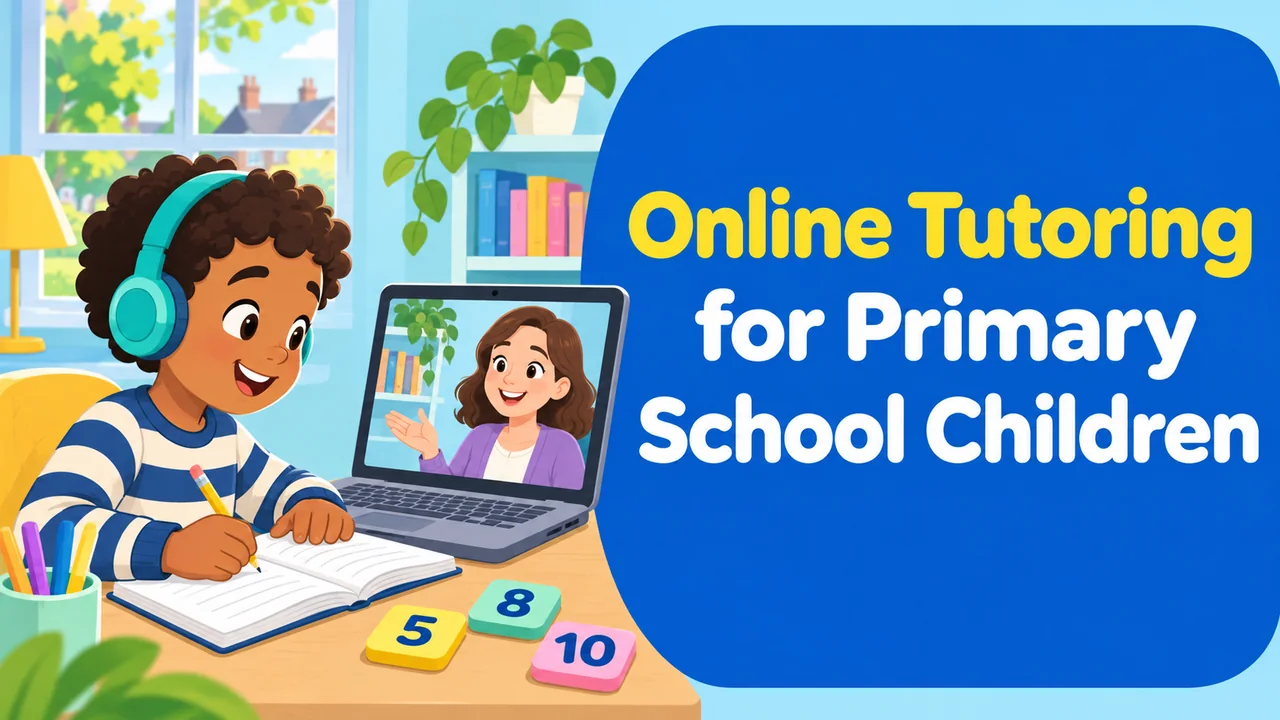
Can a child under 11 really learn effectively through a screen? It is a fair question. If you’re wondering whether your child will stay engaged on a screen, watch how the tutor gets them talking, reading, writing or showing their working. The answer is that online tutoring can work well for primary school children, but the quality and structure of the tutoring matter.
Guru At Home runs live one-to-one online lessons for primary children. What matters in online tutoring is the quality of the tutor, how closely the lesson matches your child’s schoolwork, how interactive the session is, and whether your child can stay focused with a live tutor on screen. For younger pupils, good online tutoring should feel like a conversation with guided practice, not a long video lecture.
This guide looks at the research, what tutoring can look like from Year 1 to Year 6 and how to decide whether the format suits your child.
When Online Tutoring Works for Children Under 11
Research on tutoring is broadly positive, especially when the support is targeted and given one-to-one. Across studies of one-to-one tuition, the Education Endowment Foundation (EEF) found about five additional months of progress on average compared with similar pupils who did not receive that support. In primary school studies, the estimate was about six months. Studies that used digital technology showed broadly similar effects. Results can vary from one online tutoring programme to another.
Bottom line: Ask which skill the tutor will work on first, how it connects to your child’s schoolwork and what progress you can look for.
What Does the Research Say About Online Primary Tutoring?
There are two different questions parents often combine:
- Does one-to-one tutoring help children learn?
- Does putting that tutoring online change the result?
The evidence gives useful information about both, but it does not show that every online tutoring programme will produce the same results.
| Source | What the evidence found | What it means for parents |
|---|---|---|
| NFER evaluation of the third year of the National Tutoring Programme | Small KS2 English and maths gains, around +1 month or less, across a mixed national programme. | For your child, agree a specific skill to work on. |
| EEF – Affordable Maths Tuition (Year 6 online trial) | The online Year 6 maths trial detected no improvement in KS2 maths test results. Teachers reported apparent improvements in understanding, verbal fluency and confidence. | Look at both how your child feels about maths and what they can do independently. |
| Ofsted – Independent Review of Tutoring in Schools | The weakest provision Ofsted observed involved remote tutoring through external tuition partners. Sessions were rarely linked to the school curriculum, and tutors and school staff had little contact. | Ask how a provider targets gaps. That is the real quality test. |
How Primary School Is Organised in England
In England, Key Stage 1 covers Years 1 and 2, usually ages 5 to 7. Key Stage 2 covers Years 3 to 6, usually ages 7 to 11. Reception comes before Key Stage 1. Many children turn 11 during Year 6, so this guide covers them too. How a lesson should be taught changes across these ages.
- KS1, Years 1 and 2 (ages 5 to 7): Children in Years 1 and 2 are building their reading, writing and maths skills. Lessons often need more visual support, repetition, questioning and short changes of activity.
- Lower KS2, Years 3 to 4 (ages 7 to 9): more independent practice, but still frequent questions, examples and visible working.
- Upper KS2, Years 5 to 6 (ages 9 to 11): more structure, deeper maths and English work, homework support, gap-filling and Year 6 SATs preparation where needed.
Parents can explore support by stage on the KS1 online tutoring and KS2 online tutoring pages, including dedicated Year 1 and Year 6 tutoring options.
What the Research Tells Parents About Tutoring for Primary Children
The research does not support a simple claim that online tutoring is always better than face-to-face tutoring. Instead, it points towards the importance of how tutoring is delivered.
1. One-to-one teaching is one of the strongest forms of support
A one-to-one lesson gives the tutor much more information about an individual child. The tutor can see whether a child understands a question, where they make a mistake and whether they can explain their reasoning. If a child does not understand, the tutor can change the explanation instead of moving on with the rest of the class.
Ask the tutor to identify one specific difficulty, such as remembering number bonds, comparing fractions or sounding out unfamiliar words. A clear starting point makes it easier to see what your child can do after a few sessions.
2. Progress Varies From Child to Child
NFER evaluated the third year of the National Tutoring Programme. Participation was associated with small KS2 English and maths gains equivalent to about one month of additional progress or less. Maths gains were more consistent. For your child, agree what improvement would look like. They might learn to add fractions with the same denominator or explain how they worked out the meaning of a new word.
3. Badly organised remote tutoring can fail
In the weakest remote provision Ofsted observed, external tuition partners delivered sessions with little connection to the school curriculum. Communication between tutors and school staff was poor, and schools had little say in what was taught. In some sessions, pupils chose the topics without a clear plan to address gaps in their knowledge.
For parents, the practical lesson is simple: look at how the tutoring is delivered, not just the fact that a provider offers tutoring.
Why One-to-One Online Tutoring Suits Primary Children
The tutor can slow down straight away – In a classroom, a teacher has to move a whole group forward. One-to-one, the tutor can spot hesitation, ask another question or go back to a missing step.
Children can ask questions without worrying about the class – Some pupils never put their hand up because they feel unsure. A private lesson lets them say "I don’t understand that yet" as often as they need.
Visual tools make hard ideas clearer – Shared whiteboards, diagrams, number lines, highlighted text and worked examples help in science and maths. Our Year 3 and Year 4 tutoring pages give examples of the subjects and activities we cover.
No travel makes consistency easier – Cutting travel time helps tuition fit around school, meals and family routines. For young children, though, convenience should never mean booking a lesson when they are tired.
When Online Tutoring May Not Work for a Child Under 11
Watch for these warning signs:
- Your child looks away, leaves the desk, or needs constant reminders to answer.
- The tutor talks for long stretches instead of asking your child to read, explain, calculate, write or solve.
- The work feels disconnected from school or is consistently too easy or too hard.
- Audio, video or device problems interrupt lessons again and again.
- The tutor keeps changing, so your child rebuilds trust each time.
- Your child is anxious or resistant before every session, well past the settling-in period.
Online tutoring has numerous benefits, but it still has to suit your child. If these signs continue, it does not necessarily mean online tutoring can’t work. The tutor, session length, time of day, subject focus or teaching style may need to change.
What Good Tutoring Looks Like at Each Primary Age
Years 1 and 2: Keep It Interactive
Try short activities with clear examples for children aged 5 to 7. Your child might read aloud, practise a sound, count objects or answer a quick question. A parent may need to help with logging in or setting up the device.
Years 3 and 4: Build Independence
In Years 3 and 4, a familiar routine can help your child settle in. The tutor might recap the last lesson, demonstrate a task, practise it with your child and then ask them to try one independently. They should still be doing something throughout, whether answering, reading, calculating or explaining their thinking. This is a good age to fix small gaps before they grow.
Years 5 and 6: Target Gaps and Prepare for Secondary School
Some older primary pupils may be ready to work for longer with less help. Lessons can focus on specific maths topics, reading comprehension, writing, grammar, school assessments, or getting ready for secondary school. The Year 5 tutoring page covers this stage in detail.
For Year 6, the aim is not endless test drilling. Good tutoring finds out why a question is hard and strengthens the knowledge behind it, alongside exam familiarity.
How Long Should a Session Be?
There is no perfect length for every child. Age, concentration, subject and lesson design all matter. The EEF evidence notes that short, regular sessions have often produced strong results in research settings. So put quality and attention ahead of simply making the lesson longer. A young child who stays fully involved for a shorter lesson may learn more than one who spends the second half of a long lesson tired and distracted.
Which Primary Subjects Can Children Learn Online?
Maths works well when your child can show their working and the tutor can correct mistakes straight away. Shared whiteboards and visual models make these lessons highly interactive.
English and reading lessons can cover reading aloud, comprehension, vocabulary, grammar, spelling, sentence building and planning written work. For early phonics, clear audio matters, because the English tutor and child need to hear sounds accurately.
Science can be supported through diagrams, discussion, vocabulary and problem-solving. Where practical work is involved, the tutor should use age-appropriate materials and never let the screen replace hands-on learning.
What a Good Online Primary Lesson Looks Like
A strong session has one clear goal and a proper start-to-finish shape:
- A short check-in and review of the last lesson.
- One clear target for the session.
- An explanation using examples suited to your child’s level.
- Guided practice, where tutor and child work through problems together.
- Independent attempts, so the tutor sees what your child can do unprompted.
- Immediate feedback and correction of mistakes.
- A short recap and a note of what to practise next.
Before booking, ask which identity and background checks the provider carries out and how to raise a safeguarding concern. You can browse our tutor profiles to learn about individual tutors’ subjects and experience.
How Much Should a Parent Be Involved in Primary Children’s Tutoring?
For a five- or six-year-old, it’s fine to stay nearby while they get used to the device and the routine. For an older primary pupil, constant presence can make it harder for the tutor to see what your child can manage alone.
Help with setup, stay available, then let the tutor lead. Afterwards, ask for a simple update: what was covered, what went well, what still needs work, and what to practise next. If your child waits for you to supply answers, mention it to the tutor and agree how to help them take part more independently.
Is Your Primary Child’s Tutoring Working? A Parent Checklist
Do not judge only by whether your child says the tutor is nice. A good relationship matters, but you should also see signs of learning.
Before you book regular lessons, check that:
- Your child can hear and see the tutor clearly on your device.
- Your child can stay involved in a live conversation for the planned length.
- The tutor knows your child’s year group and current schoolwork.
- Your child will be asked to answer, read, write, calculate or explain during the lesson.
- The tutor stays the same from week to week.
After a few weeks, look for:
- Your child can explain something they could not explain before.
- Homework on that topic needs less help.
- The tutor names specific strengths and gaps instead of giving vague feedback.
- The same mistake appears less often.
- School feedback starts to show the same picture.
Progress does not have to be dramatic every week. What you want is a clear direction of travel, and a plan that responds to what your child is learning.
Frequently Asked Questions
Can a Five-Year-Old Do Online Tutoring?
Some five-year-olds can take part in a short, interactive online lesson with a parent nearby to help with setup. See whether your child joins in, answers questions and feels comfortable asking for help. If they struggle to settle after you’ve tried adjusting the time or lesson format, consider taking a break or trying a different format.
Does Online Tutoring Work for Year 6 SATs Preparation?
It can help Year 6 pupils close specific English and maths gaps and get familiar with SATs-style questions. The strongest tutoring teaches the concept underneath the question rather than only drilling past papers.
How Many Sessions Does a Primary Child Need Each Week?
There is no universal number. It depends on your child’s needs, the quality of each lesson, school workload, and how much practice happens in between. Consistency beats irregular bursts.
What If My Child Gets Distracted During Lessons?
Check the cause first: lesson timing, device notifications, a noisy room, a session that runs too long, or teaching that is too passive. Ask the tutor to increase questioning and active practice. If it continues after reasonable changes, another format may suit your child better.
How Quickly Should I Expect to See Results?
Agree one specific goal with the tutor and decide when to review it. An early sign of progress might be that your child can solve a familiar type of problem without a prompt or explain a method in their own words. If the same difficulty persists at the review, ask what the tutor plans to change.