
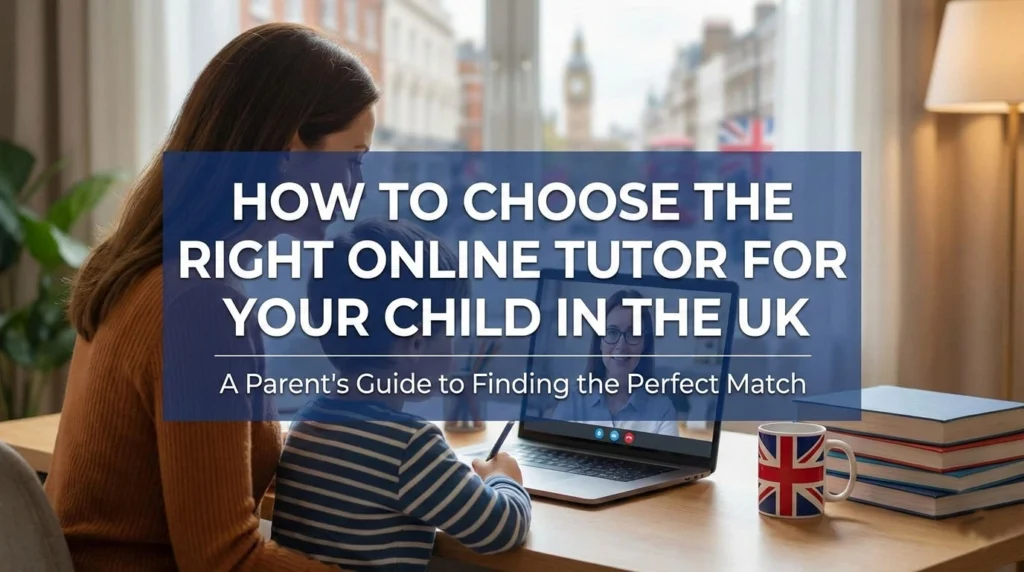
Your child brings home another poor test result and the teacher’s note says they are falling behind. You try to help with homework, but the teaching methods have changed. The UK National Curriculum looks nothing like what you studied years ago, and it often feels like you are speaking a different language from your child’s school.
UK state schools typically have around 25 to 30 students per class, which means your child receives very little individual attention. They may feel embarrassed to ask questions, and lessons move too quickly for them to keep up. Small gaps in understanding in Year 7 can become major problems by Year 9 or Year 10.
As a parent, this is often the moment when you start looking for extra support. You want someone who can explain difficult topics clearly and give your child the attention they cannot get in a crowded classroom. That is when you realise the next challenge is choosing the right kind of tutor.
The Difficulty of Choosing the Right Online Tutor
When you start looking for an online tutor in the UK, the number of choices can feel overwhelming. Every option looks different and comes with its own challenges.
1. The Independent Online Freelancer
These tutors often advertise on sites like Gumtree or social media. They may cost less, but they usually work alone. If they become ill, stop responding, or get too busy, there is no backup and no support if something goes wrong.
2. The Large Online Platform
These platforms list hundreds of tutors with minimal guidance. You are left scrolling through profiles, comparing reviews, and trying to check qualifications yourself. You end up acting as the HR manager and quality controller, which can be stressful and time-consuming.
3. The Premium Online Agency
These agencies carefully vet tutors, which is reassuring, but their UK-based overheads often push prices to £40 to £60 per hour. The quality may be strong, but the cost puts this option out of reach for many families.
Where Does Guru At Home Fit?
Guru At Home is not a directory, not a loose group of freelancers, and not a high-fee UK agency. It is a specialised online tutoring service that combines curriculum oversight, safeguarding, and strong teaching standards with one-to-one lessons at an accessible price.
Choosing the right tutor still depends on your child’s unique needs. To make the best decision, you first need to understand exactly what kind of support your child requires.
Step 1: Diagnose Your Child’s Specific Online Need
Before hiring an online tutor, you must identify the actual problem. An online platform suited for quick revision is very different from a tutor needed for deep remedial work.
1. The Foundation Gap
Your child missed fundamental concepts in Years 4 to 6. Now in Year 8 or 9, algebra makes no sense because the foundation is missing.
You need an online tutor who uses digital diagnostic tools to identify these gaps, rather than simply screen-sharing current homework. So, look for a tutor who is willing to pause the current syllabus and rebuild the basics using visual digital aids.
2. Exam Technique Problems
Your child understands the material but consistently fails tests. They may run out of time or misread questions.
The Online Context: You need an online exam coach who can share past papers on screen and mark them in real time using digital ink to show exactly where marks are lost.
The Solution: The focus must be on exam strategy and marking criteria, not just subject content.
3. Confidence Issues
Your child feels lost in large classes and refuses to ask questions. You need a safe, private online video environment where no other students are watching. This reduces pressure and encourages your child to ask questions.
You should prioritise one-to-one video lessons over group calls to build confidence and psychological safety.
Step 2: Verify UK Curriculum and Syllabus Awareness
The biggest risk with online tutoring is hiring someone who does not understand how British schools operate or how the syllabus changes.
1. Awareness of New Syllabus Changes
The UK curriculum evolves. A tutor who taught Physics five years ago may not know the current Required Practicals list.
Parental Action: Ask directly: “Are you up to date with the latest 2024 to 2025 syllabus changes for my child’s exam board?” An effective tutor keeps up with these updates so they are not teaching outdated material.
2. Why Exam Boards Matter
Schools choose exam boards such as AQA, Edexcel, OCR, or WJEC. A tutor outside the UK may not know which text or specification your child is studying.
- English Literature: AQA may require Macbeth, while Edexcel may require Romeo and Juliet. Preparing the wrong text wastes valuable learning time.
- Maths: There is a massive difference between the Foundation and Higher tiers. A maths tutor teaching circle theorems to a Foundation student via a webcam is a waste of screen time.
Parental Action: Always verify that your tutor knows your child’s exam board and has the correct digital resources.
If your child is preparing for GCSEs, you can read more about how our GCSE tutors support students across different exam boards.
Step 3: Assess Digital Competency (Teacher and Student)
When it comes to online lessons, knowing how to use the digital tools matters just as much as knowing the subject. Both the tutor and your child need to feel comfortable with the setup.
A modern online tutor cannot just talk on camera. They must explain concepts visually. The tutor should use an interactive whiteboard to draw diagrams, map out essay structures, and solve equations in real time.
For Science students, the online chemistry tutor should use virtual labs and simulations. Since they cannot perform physical experiments, software demonstrations of the required practicals help the student understand the method clearly.
Step 4: Verify Online Qualifications and Experience
A good-looking profile does not guarantee that the tutor is qualified. The barrier to becoming an online tutor is low, so it is important to check their qualifications carefully.
Minimum Requirements
- Academic Qualifications: They must hold a degree in the subject they teach.
- Teaching Qualification: A PGCE, QTS, or an equivalent qualification shows they have learned how to teach, not just the subject content.
- Online Experience: Teaching via Zoom or Teams requires different skills than teaching in a classroom. Look for at least two years of online teaching experience to make sure they can handle the technical side smoothly.
How to Verify Their Qualifications
- Request digital copies of their degree certificates.
- Read reviews that mention online reliability, such as connection stability and punctuality.
Making the right choice for your child starts with asking the right questions. Use our essential guide, which includes 16 key questions every parent should ask before hiring an online tutor.
Step 5: Choose the Right Online Tutoring Format
Pre-Recorded Videos
Pre-recorded video platforms, such as BBC Bitesize, offer access to massive libraries of content that can be quite useful for general revision and broad overviews. However, the fundamental flaw of this approach is that it is completely passive. If a child gets stuck on a specific concept, the video cannot adapt or explain it differently, often leading to significant frustration. Without an interactive element to unblock them, the student is left without support when they need it most.
Group Online Classes
Group online classes are often selected because they are a more affordable alternative to private tuition, but this cost-saving often comes at the expense of engagement. In a group setting, it is easy for a child to remain passive and silent behind a muted microphone, effectively “hiding” during the lesson. Because the teacher’s attention is divided, this format is generally ineffective for identifying and fixing specific, individual learning gaps that require focused attention.
The Hybrid Model (Live Plus Recorded)
The hybrid model, exemplified by The Guru At Home approach, consistently delivers the strongest results by combining real-time engagement with a safety net for review. The live, one-to-one teaching ensures the child is actively participating and receiving immediate feedback, while the recording feature adds a layer of long-term utility. Because every session is saved to the cloud, students can revisit complex explanations whenever they wish, making this combination of active learning and on-demand review far more effective than live lessons alone.
Step 6: Ensure Online Safety and Safeguarding
Inviting a tutor onto your child’s screen comes with responsibility, so strong digital safeguarding is essential.
Enhanced DBS Checks
For UK-based tutors, request an Enhanced DBS. For international tutors, request an equivalent recent police clearance or ICPC from their country of residence. Tutors living outside the UK are unable to obtain a UK Enhanced DBS check. They can only provide a local police check or an ICPC (International Child Protection Certificate).
Parental Action: The certificate should be recent (within the last year). Ask the online agency or freelancer to show it on camera or provide a digital copy.
Platform Security
Use professional platforms such as Zoom or Teams with password-protected links. Avoid tutors who want to teach through unmonitored apps like WhatsApp, Snapchat, or personal social media.
Payment Protection
Use payment systems that offer buyer protection. Avoid direct bank transfers to unknown online freelancers. If they disappear, there is no way to recover your money.
Step 7: Look for Mentorship and Creativity, Not Just Teaching
A great tutor does more than follow the syllabus. They also act as a mentor who builds confidence, creativity, and genuine interest in the subject.
Moving Beyond Rote Learning
The best online tutors use digital tools to make learning inspiring. They might use digital art platforms to bring Geometry to life or online storytelling tools to strengthen Creative Writing.
- The Goal: You want a tutor who encourages your child to ask “Why?” instead of only “How?”. This style of teaching builds critical thinking skills that are essential for A Level and university success.
- The Result: When a student feels mentored rather than just instructed, their motivation grows naturally. This shift often leads to better grades and a stronger connection to the subject.
Step 8: Compare Online Costs and Value
Typical UK Online Pricing
- UK-based Agencies: £25–45 per hour.
- Freelancers: £20–£50+ per hour (highly variable).
- International Platforms: £5–£15 per hour.
The online nature of tutoring gives you access to global talent. This is why many international tutors on platforms like Guru At Home charge £5–15 per hour. They often hold Master’s degrees and have strong experience with the UK curriculum, but their lower living costs mean they can offer high-quality support at much more affordable rates.
When comparing prices, always look at value rather than the hourly number. A £10 tutor with bad WiFi and no plan is still a waste of money. A £35 tutor who helps your child jump a grade is excellent value. Guru At Home sessions start at £8.99 per hour because the online model reduces overheads while still maintaining high UK teaching standards.
Step 9: Monitor Progress and Results
Hiring an online tutor is not the end of the process. You still need to monitor how things are going to make sure your child is actually improving.
1. Set Clear Goals and Start Small
Begin with a block of 4 to 8 online sessions. Set a clear goal for this period, for example: “Pass the next Algebra test” or “Improve confidence with fractions.”
2. Listen to Your Child
After each lesson, ask simple questions:
- “Did the connection work well?”
- “Could you use the whiteboard easily?”
- “Do you like the tutor?”
If your child hesitates or dreads logging in, something is wrong with the tutor, the format, or the setup.
3. Require Regular Digital Feedback
Ask for monthly progress reports. Generic phrases like “doing well” are not helpful. You need specific information about the exact topics covered and how your child is improving.
How Guru At Home Solves Common Parent Concerns
Guru At Home removes the usual frustrations of online tutoring by combining the safety of a trusted agency with the tools and efficiency of a modern learning platform.
- Advanced Digital Tools: Our tutors are trained to use interactive whiteboards and digital simulations, making lessons visual, hands-on, and far more engaging than a basic video call.
- Verified UK Curriculum Expertise: We test every tutor on UK exam boards such as AQA and Edexcel, as well as the relevant Key Stages, so your child learns the right content from day one.
- Genuine One-to-One Support: No group classes. Every session is focused entirely on your child.
- Hybrid Learning: You get live one-to-one teaching plus cloud-recorded lessons your child can rewatch anytime.
- Transparent, Affordable Pricing: Online sessions start at £4.99 per hour, making high-quality support accessible without sacrificing standards.
- Professional Safeguarding: All tutors meet strict safety checks, including full identity verification.
- Risk-Free Trial: You can test the online classroom before making any commitment.
Conclusion
Choosing the right online tutor means navigating a complex mix of agencies, freelancers, and platforms. You must check UK curriculum knowledge, make sure both the tutor and your child can use digital tools effectively, and confirm digital safety through DBS checks.
The right online tutor can transform your child’s education from home. Confidence grows. Understanding deepens. Grades improve.
You do not need to spend £40 per hour for quality UK curriculum tutoring. Guru At Home proves that expert online teaching can be both affordable and effective.
Visit Guru At Home today to book your free online trial session.
Frequently Asked Questions
How do I know if my child needs an online tutor?
Signs include poor test results, homework struggles, or a teacher saying they are falling behind. If your child is shy in class, the privacy of a one-to-one online session often helps them open up and build confidence quickly.
What qualifications should an online tutor have for UK students?
They should have a degree in the subject they teach and ideally a teaching qualification such as PGCE or QTS. For online tutoring, they also need an Enhanced DBS check and specific knowledge of your child’s exam board, such as AQA or Edexcel.
Is online one-to-one tutoring better than group sessions?
Yes, in group classes, students often mute their mics and stay quiet. In one-to-one online lessons, the tutor works at your child’s pace and keeps them actively involved using the interactive whiteboard.
How can I check if an online tutor is safe?
Ask for a digital copy of their Enhanced DBS check (dated within the last year). Use professional platforms such as Zoom or Teams and avoid personal social media for lessons. Always use protected payment methods instead of direct bank transfers.
What equipment does my child need?
A laptop or tablet with a working camera is essential. For Maths and Science, we recommend a simple USB graphics tablet (around £30) so your child can write naturally on the digital whiteboard instead of using a mouse.