
Boost Your Child’s Confidence with a Specialist Online Maths Tutor for KS3
Year 7 is when many bright pupils start to lose confidence in maths. The jump from Year 6 to secondary school maths is sharp. The pace increases, algebra arrives, and simple number work turns into abstract mathematical thinking. Research into the well-known Year 7 dip has shown that many pupils experience slower progress in maths during the transition to secondary school.
By Year 9, schools are already setting pupils into Foundation or Higher GCSE pathways. The decisions made now can shape what grades your child is able to aim for in Year 11.
That is why KS3 online maths tutoring has become one of the most requested services at Guru At Home UK. Our experienced Indian maths teachers deliver live, one-to-one lessons that follow the National Curriculum for Mathematics at Key Stage 3, helping pupils build the strong foundation needed for GCSE Maths success.
Why Parents Choose Guru At Home For KS3 Maths Tuition
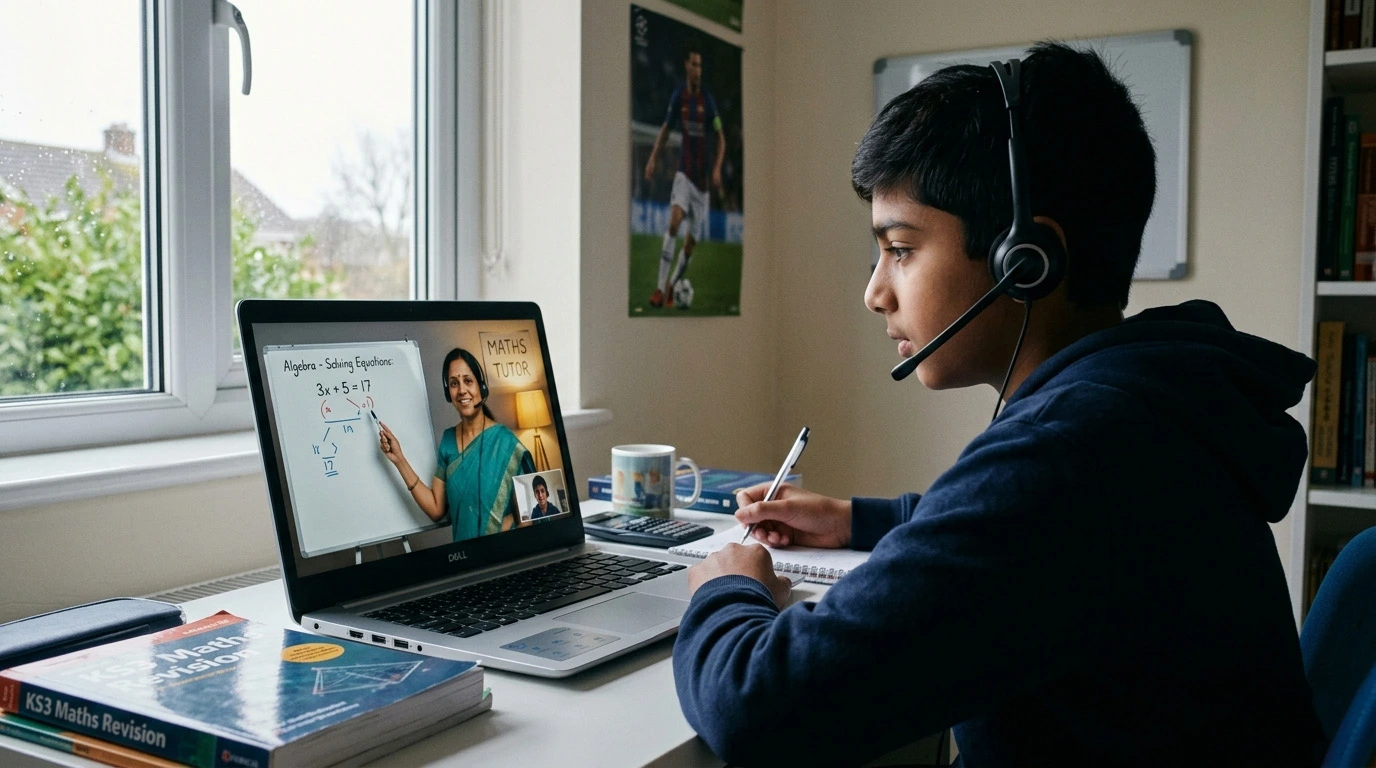
- Live One-to-One Lessons On A Digital Whiteboard: Every session is a dedicated, one-to-one lesson between your child and their maths tutor. We use an interactive digital whiteboard so the tutor and your child can work through equations, sketch graphs, draw nets of 3D shapes, and solve problems together in real time. Your child is never one face in a crowded class of thirty. They receive the tutor’s full attention throughout the lesson.
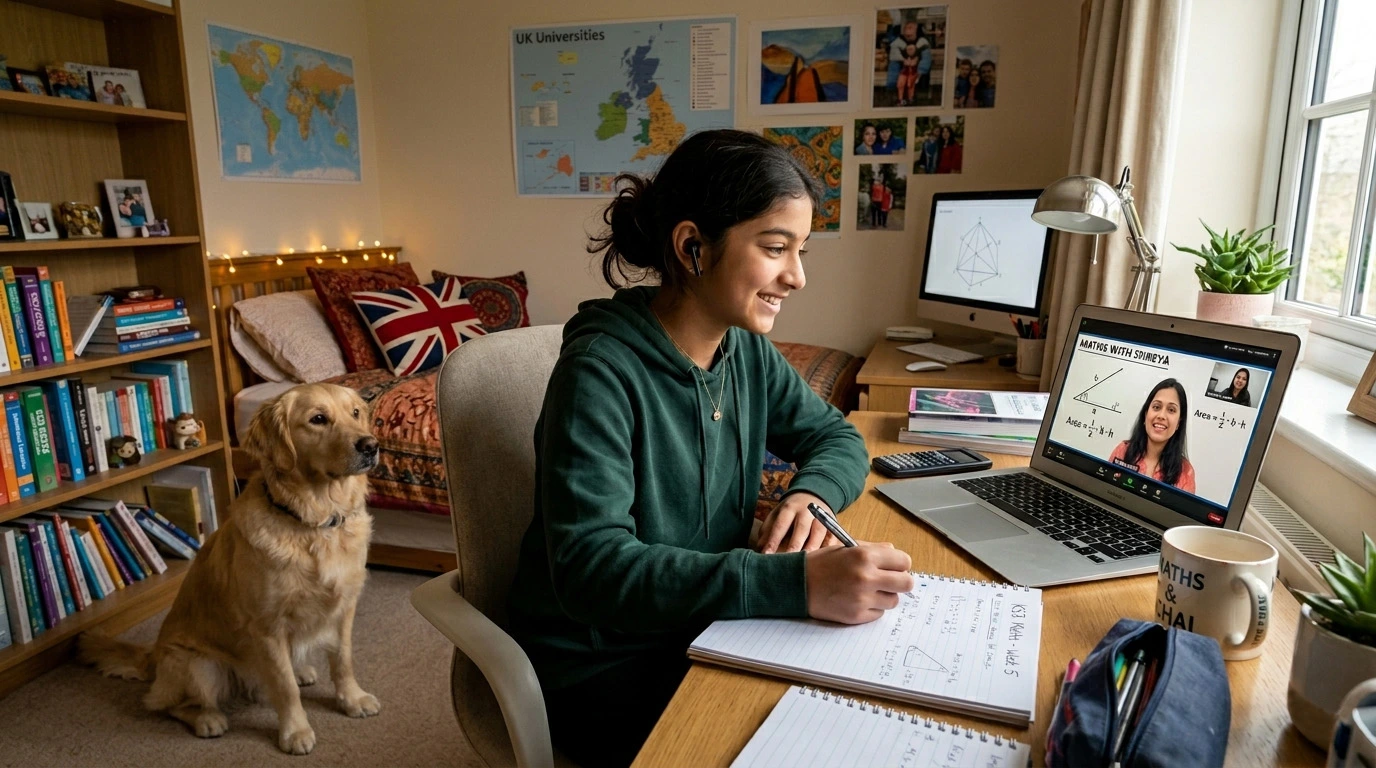
- Tutors Who Understand The UK National Curriculum: Our maths tutors hold degrees from respected Indian universities, including the IITs, NITs, and other leading institutions. Many also hold Master’s degrees or PhDs in Mathematics. Every KS3 tutor is trained on the UK National Curriculum and major GCSE exam boards, including AQA, Edexcel, OCR, and WJEC Eduqas, so they understand how Year 7, 8, and 9 maths builds towards GCSE success.
- Honest, Affordable Pricing For UK Families Private maths tuition in the UK now costs anywhere from £26 to £60 per hour for KS3 level. Guru At Home offers significantly lower rates without cutting corners on quality. We can do this because our tutors are based in India, where mathematics teaching is one of the most respected professions. You get IIT-level mathematical thinking at a price that works for an ordinary family budget.
- Free Trial Class Before You Commit Book a free trial lesson to watch a live session and see how your child responds to the tutor. There are no card details required and absolutely no commitment. If you feel it is not the right fit, there is nothing to pay.
- Recorded Lessons For Revision Every KS3 maths session is recorded, allowing your child to revisit explanations whenever they need extra support or revision. Parents can also review lesson recordings to track progress and understand what has been covered. This is especially useful before end-of-term tests, CATs, and summer assessments that many schools use to guide Year 9 GCSE tier placement.
Year 7 Maths Tutoring (Ages 11-12) — Building Secondary Foundations
Year 7 is the bridging year between primary and secondary maths. Pupils move from concrete number work into the early stages of abstract algebra. Schools usually use the first term to revisit and build on KS2 knowledge before introducing new concepts.
Core Year 7 maths topics our tutors cover:
- Place value with very large and very small numbers; rounding to significant figures
- Four operations with positive and negative integers; BIDMAS order of operations
- Prime numbers, factors, multiples, HCF and LCM
- Fractions, decimals and percentages; converting between all three
- Introduction to algebraic notation: writing expressions, substituting values, collecting like terms
- Solving simple linear equations in one variable
- Function machines and input-output tables
- Ratio notation and direct proportion problems
- Properties of 2D and 3D shapes; angles in triangles and on a straight line
- Basic data handling: mean, median, mode and range; tally charts and bar charts
If your child has just moved up from Year 6 and is struggling with the pace, our Year 7 maths tutoring sessions are designed to close gaps quickly and rebuild confidence before bad habits set in.
Year 8 Maths Tutoring (Ages 12-13) — Where Algebra Takes Centre Stage
Year 8 is the year algebra becomes the heart of the maths curriculum. By the end of Year 8, pupils should feel confident with linear equations, sequences, and the early language of mathematical proof.
Core Year 8 maths topics our tutors cover:
- Calculations with fractions, decimals, powers and roots
- Standard form (introduction)
- Estimation and rounding to a given degree of accuracy
- Linear equations with brackets and unknowns on both sides
- Sequences: term-to-term rules and finding the nth term of a linear sequence
- Plotting and interpreting graphs of linear functions
- Percentage increase and decrease; reverse percentages; compound interest basics
- Direct and inverse proportion in real-life contexts
- Area and volume of more complex shapes; circles: circumference and area (using π)
- Constructions with ruler and compasses; loci basics
- Probability: outcomes, theoretical vs experimental probability, Venn diagrams
- Scatter graphs and correlation
Many parents find their child needs extra support in Year 8 maths because the pace in school moves too quickly. Our Year 8 maths tutor programme slows the pace for your child without letting them fall behind the school curriculum.
Year 9 Maths Tutoring (Ages 13-14) — The GCSE Launch Pad
Year 9 is the year many schools begin guiding pupils towards Foundation or Higher GCSE entry. Most schools also start introducing GCSE maths content during Year 9. Some pupils sit early GCSE practice papers or internal end-of-Year-9 exams that help determine GCSE tier placement.
Core Year 9 maths topics our tutors cover:
- Index notation, surds and standard form
- Upper and lower bounds in calculations
- Solving simultaneous equations by substitution and elimination
- Expanding double brackets; factorising quadratic expressions
- Quadratic sequences and graphing quadratic functions
- Solving linear inequalities and representing solutions on a number line
- Direct and inverse proportion, growth and decay problems
- Pythagoras’ theorem in 2D
- Introduction to trigonometry (SOH CAH TOA in right-angled triangles)
- Circle theorems and basic geometric proof
- Constructions and loci; further transformations
- Cumulative frequency graphs, box plots
- Probability tree diagrams and conditional probability basics
By the end of Year 9, your child should feel confident starting GCSE Mathematics at either Foundation or Higher tier. Our Year 9 maths tutor lessons are designed to bridge KS3 into GCSE preparation, creating a smooth transition into Year 10.
The Six Strands Of KS3 Maths We Cover In Full
Whichever year your child is in, our tutors structure their teaching around the six DfE strands of the KS3 maths programme of study.
1. Number
Place value, integers, decimals, fractions, percentages, indices, surds, standard form, prime factorisation, HCF and LCM, BIDMAS, rounding and estimation, upper and lower bounds.
2. Algebra
Algebraic notation, simplifying expressions, expanding brackets, factorising, linear equations, simultaneous equations, sequences (linear and quadratic), nth term, function machines, graphs of linear and quadratic functions, inequalities, substitution.
3. Ratio, Proportion and Rates of Change
Ratio notation, dividing in a ratio, direct and inverse proportion, percentage change, compound interest, growth and decay, scale drawings, real-life proportion problems.
4. Geometry and Measures
Properties of 2D and 3D shapes, angles in parallel lines and polygons, area, perimeter, surface area and volume, circle theorems (introduced), Pythagoras’ theorem, basic trigonometry, transformations (translation, reflection, rotation, enlargement), constructions and loci, vectors (introduced).
5. Probability
Probability scale, listing outcomes, theoretical vs experimental probability, mutually exclusive events, Venn diagrams, two-way tables, tree diagrams (introduced).
6. Statistics
Mean, median, mode and range; bar charts, pie charts, frequency tables, scatter graphs and correlation, cumulative frequency, box plots, comparing distributions.
This is not a marketing list. This is what your child actually needs to know to be ready for GCSE Mathematics, paper-by-paper, exam-board-by-exam-board.
Trusted By Parents
Guru At Home has earned parents’ trust by consistently providing high-quality, personalized educational support to students across the UK. Our reputation as a leading online tuition provider is built on our commitment to student success and our ability to meet diverse learning needs. Here’s why parents choose and trust our platform.
Posted on Google Priti Aggarwal2 October 2026
Trustindex verifies that the original source of the review is Google.
We are very happy with the teaching style of Navtej kaur mam. The progress and support our child has received this year is amazing. Thank you for being such a caring and dedicated teacher. Thanks you for your continuous support.Posted on GoogleNarinder1 October 2026We are very happy with Binisha as a tutor\. We are based in the UK, and from the very beginning, she has been kind, patient, supportive, and very professional\. Our kids really enjoy her classes and are always happy and excited to study with her\. She explains everything clearly and makes the lessons fun and interesting, which helps the children stay focused and engaged\. We have noticed a positive improvement in their learning and confidence\. Binisha is very understanding and takes the time to make sure the children understand each topic properly\. She creates a friendly and comfortable learning environment where the kids feel confident to ask questions and learn at their own pace\. We are very pleased with her teaching and would highly recommend Binisha to any parents looking for a caring, dedicated, and excellent tutor\. Thank you, Binisha, for all your hard work and support\!Posted on GooglePragathi Nambiar1 October 2026Kind ,consistent and encouraging teaching . Ms Navtej is committed to teaching Hindi in very systematic way. The kids are looking forward to the class always .Posted on GoogleAmritpal Kaur Kohli1 October 2026Excellent tutoring service! The teachers are professional, patient, and genuinely dedicated to their students. Great communication and smooth coordination as well. Really happy with the overall experience—highly recommended!Posted on GoogleGAYATRI PATEL1 October 2026Great online classes! The lessons are clear, well-structured, and easy to follow. The instructors are very supportive and explain complex concepts in a simple way Highly recommend to anyone looking to learn at their own pacePosted on GoogleRekha Deepu18 September 2026Huge thanks to Guru at Home Tutoring! Finding flexible tutoring with great teachers isn't easy, but they’ve been amazing. My kids have had fantastic teachers like Ms. Ekshita, Ms. Mamta, Ms. Shubasree, and Ms. Raman over the years. Currently, they’re studying with Ms. Mamta and Ms. Shubasree, and the classes are always engaging. The teachers build such a good connection with the kids that they feel like approachable mentors rather than strict tutors, which makes asking doubts so easy. Very happy with their service!Load more
How Our Online KS3 Maths Lessons Work
Step 1: Free Diagnostic Assessment
Before any paid lessons begin, we run a free 30-minute diagnostic session with your child. The tutor identifies which KS3 topics are secure, which need improvement, and where learning gaps exist. You then receive a clear written summary.
Step 2: A Dedicated Maths Tutor (Same Tutor, Every Lesson)
Your child is matched with a dedicated KS3 maths tutor. Because they work with the same tutor every week, the tutor understands exactly what your child struggled with in the last lesson and how to help them improve in the next.
Step 3: A Personalised Learning Plan
The tutor creates a written learning plan linked to your child’s school topics and exam board. If your child studies AQA, the plan follows AQA. If the school uses Edexcel or OCR, the lessons reflect that. The plan updates as your child progresses.
Step 4: Live Interactive Lessons
Lessons take place on Zoom or through our secure online classroom using an interactive digital whiteboard, screen sharing, and live voice and video. Your child can ask questions at any point, and the tutor can stop, redraw, and explain concepts again whenever needed.
Step 5: Homework, Practice And Past Paper Work
Pupils receive practice questions between lessons, including topic-based worksheets and, in Year 9, early GCSE-style questions based on major exam board specifications.
Step 6: Monthly Progress Reports For Parents
You receive a clear monthly report showing topics covered, areas mastered, and the focus for the next month. No vague feedback. Just clear maths progress.
Frequently Asked Questions
Any time during Years 7, 8 or 9 is a good time to start. Year 7 helps prevent the “Year 7 dip” before it begins. Year 8 catches and fixes algebra gaps before they become serious. Year 9 builds GCSE-readiness and influences Foundation versus Higher tier placement decisions made by schools.
Yes. All our KS3 maths tutors are trained on the major UK GCSE specifications, including AQA, Edexcel (Pearson), OCR and WJEC Eduqas. We adjust the lesson content to match your child’s school exam board so the tuition supports rather than competes with classroom learning.
Standard sessions are 60 minutes. Some pupils, particularly in Year 7, prefer 45-minute lessons until they build stamina for longer maths sessions. We also offer 90-minute deep-dive sessions for Year 9 pupils preparing for early GCSE-style assessments.
Most KS3 pupils benefit from one to two lessons per week. A single weekly lesson maintains pace, while two lessons can noticeably accelerate progress.
Yes. Continuity is one of the most important features of effective tutoring. Your child has the same dedicated online maths tutor for KS3 every session. The tutor learns your child’s pace, gaps and strengths. If at any point you feel the match is not right, we switch tutors at no cost.
Absolutely. Many of our KS3 maths pupils attend independent schools and grammar schools. We also support pupils preparing for Common Entrance or scholarship maths papers, and pupils sitting CAT4 assessments.
Yes. Every KS3 maths lesson is automatically recorded and made available to parents and the pupil. Recordings are particularly useful before end-of-topic assessments and for catching up if a pupil misses school.