
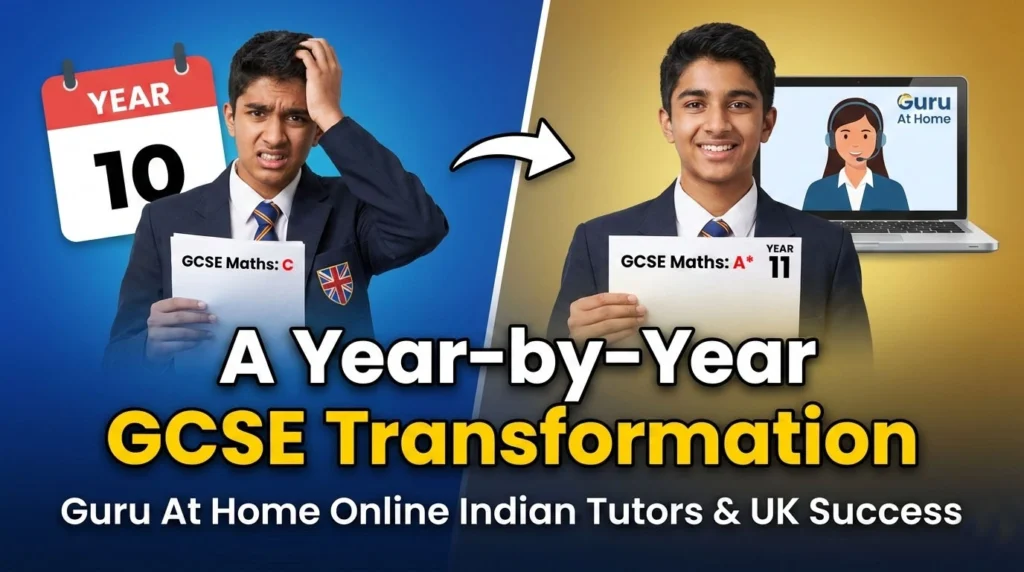
Many parents wonder how their child can move from struggling with maths to achieving higher grades. At Guru At Home, this transformation is not magic; it is a structured, year-by-year Online GCSE maths approach that helps students progress from grade 4 in Year 8 to grade 8 by Year 11.
This blog explains what happens at each stage, highlighting the key methods and focus areas that build skills and confidence over time, whether your child is in Year 8, 9, or 10.
Why Students Get Stuck at Grade 4
Before we look at the solution, let us understand why so many students plateau at lower grades.
Here is what typically happens: A student misses one concept in Year 7 or Year 8. Perhaps they did not fully understand how to work with negative numbers. They nod along in class, too embarrassed to ask questions. Then the next topic comes along, and it builds on that missed concept. The gap grows wider.
By the time they reach Year 10 or 11, they are trying to learn advanced algebra while still struggling with basics from two years ago. Their confidence drops. They start believing they are simply “not a maths person.” This belief becomes self-fulfilling.
The good news? This pattern can be broken. But it requires a structured approach that addresses gaps, builds confidence, and prepares students specifically for the GCSE grading system success.
The Guru At Home Year-by-Year Transformation
Our approach is not about cramming or quick fixes. We have found that lasting improvement comes from a carefully planned journey that respects how students actually learn. Here is exactly what happens at each year level.
Year 8 (Ages 12–13): Starting at Grade 4, Finding the Gaps, and Rebuilding Foundations
The Starting Point
When a student joins us in Year 8 with a grade 4, we do not immediately start teaching Year 8 content. First, we need to understand exactly where the problems started. Our tutors conduct a thorough assessment that goes back to Year 6 and Year 7 concepts.
What Our Tutors Do in Year 8
- Diagnostic Testing: Our online tutors use targeted questions to find exactly which topics are causing problems. Is it fractions? Negative numbers? Basic algebra? We pinpoint the specific gaps rather than guessing.
- Foundation Repair: While keeping up with current school work, we dedicate time each session to filling those gaps. If a student cannot work confidently with decimals, we fix that before moving on.
- Building Mathematical Thinking: Year 8 is where we teach students how to actually think mathematically. We use real-life examples like budgeting and cooking to show that maths is not just classroom exercises.
- Confidence Building: Many Year 8 students have already decided they are bad at maths. We work deliberately to change this mindset by celebrating small wins and showing them they can master concepts they thought were impossible.
Topics We Focus On
In Year 8, the Key Stage 3 curriculum introduces more complex ideas. Our tutors ensure students master:
- Number operations, including advanced work with decimals, fractions, and percentages
- Basic algebra, including equations and inequalities
- Geometry fundamentals, including angles, transformations, and volume
- Introduction to statistics and probability, including data handling and analysis.
What Parents See by the End of Year 8
A student who started at grade 4 typically moves to a solid grade 5 by the end of Year 8. More importantly, they begin to actually enjoy maths sessions. They ask questions in class. They attempt homework independently. The foundation is being laid.
Year 9 (Ages 13–14): Progressing from Grade 5, Bridging to GCSE, and Building Momentum
The Critical Transition Year
Year 9 is often underestimated. Many parents think the pressure only starts in Year 10. But actually GCSE preparation in year 9 should begin. This is the year that separates students who achieve top grades from those who struggle throughout their GCSEs.
What Our Tutors Do in Year 9
- Early GCSE Introduction: We begin introducing GCSE-style questions and exam techniques. Students learn the difference between how questions are asked in school tests versus GCSE papers.
- Deeper Concept Exploration: The Year 9 curriculum goes deeper into algebra, geometry, and statistics. Our tutors ensure students understand the ‘why’ behind every method, not just the ‘how’.
- Study Skills Development: We teach students how to revise effectively. This includes note-taking strategies, practice question techniques, and time management for longer problems.
- Problem-Solving Training: GCSE maths requires students to apply knowledge to unfamiliar problems. We start training this skill in Year 9, so it becomes natural by exam time.
Topics We Focus On
Year 9 follows the National Curriculum with content that directly leads to GCSE. We cover: Advanced number work, including fluency with calculations, fractions, decimals, percentages, indices, and sequences. Algebraic manipulation, including expanding brackets, factorising, and solving equations. Geometry and measures, including angles, transformations, trigonometry basics, area, volume, and coordinate geometry. Ratio, proportion, and probability, including scaling, probability models, and statistical representations.
What Parents See by the End of Year 9
A student who was in grade 5 by the end of Year 8 typically reaches a confident grade 6 by end of Year 9. They are now keeping pace with or ahead of their classmates. They approach maths with curiosity rather than fear. They understand that GCSE is coming and feel prepared rather than anxious.
Year 10 (Ages 14–15): Progressing Toward Grade 7 as GCSE Preparation Begins in Earnest
The Acceleration Phase
Year 10 marks the official start of Key Stage 4 and GCSE coursework. This is where all the foundation work from Years 8 and 9 pays off. Students who have been with us from earlier years can now accelerate their learning because they have no gaps holding them back.
What Our Tutors Do in Year 10
- Exam Board Alignment: We align all tutoring with the specific exam board your child is following, whether that is AQA, Edexcel, OCR, or another board. Each exam board has different question styles and marking schemes. We teach these specifics.
- Syllabus Coverage: We ensure complete coverage of the GCSE syllabus, identifying any topics the school might rush through or skip. Nothing is left to chance.
- Past Paper Introduction: Students begin working with past papers. We teach them how to decode what examiners are really asking, how to structure answers for maximum marks, and how to manage time across different question types.
- Higher Tier Targeting: For students aiming for grades 7-9, we focus on higher-tier content. This includes advanced algebra, complex geometry proofs, and multi-step problem solving that appears on higher papers.
Topics We Focus On
The Year 10 GCSE curriculum covers significant ground. We ensure mastery of: Advanced algebra, including mastery of algebraic expressions, equations, inequalities, and sequences. Geometry and measures, including a detailed study of shapes, angles, area, volume, transformations, and trigonometry fundamentals. Statistics and probability, including extensive practice in handling, interpreting, and analysing data sets and probability scenarios. Number skills, including mastery of fractions, decimals, percentages, ratios, proportions, and advanced arithmetic for complex problem solving.
What Parents See by the End of Year 10
A student who was in grade 6 by the end of Year 9 typically reaches a strong grade 7 by the end of Year 10. They are completing homework without stress. They can explain mathematical concepts to others. They are beginning to see how different topics connect. Mock exams go well.
Year 11 (Ages 15-16): Final Push to Grade 8 and Beyond
The Exam Mastery Phase
Year 11 is the culmination of everything. The student who started at grade 4 in Year 8 is now aiming for grade 8 or 9. All the foundation work, all the gap-filling, all the confidence-building come together in this final year.
What Our Tutors Do in Year 11
- Intensive Exam Practice: We work through past papers systematically. Students learn to recognise question patterns, understand mark schemes, and know exactly what examiners want to see.
- Weakness Elimination: We identify any remaining weak topics and address them with focused sessions. There is no room for surprises in the final exams.
- Time Management Training: Students learn exactly how long to spend on each question type. They practice under timed conditions so exam day feels familiar, not stressful.
- Grade 8 and 9 Techniques: For the highest grades, students need to show exceptional mathematical reasoning. We teach techniques for tackling the most challenging questions that separate grade 7 from grade 8 and 9.
- Mock Exam Analysis: After each mock exam, we conduct a detailed analysis. We identify exactly where marks were lost and create targeted revision plans.
Topics We Focus On
We ensure complete mastery of all GCSE content with special attention in year 11 to: Advanced algebra, including quadratic equations, simultaneous equations, graph plotting, and algebraic manipulation. Geometry and trigonometry, including advanced geometry, trigonometric identities, circle theorems, vectors, and complex shape calculations. Statistics and probability, including data representation, statistical analysis, interpreting complex datasets, and probability theory. Problem-solving, including multi-step problems that combine multiple topic areas.
What Parents See by GCSE Results Day
The student who started at grade 4 in Year 8 achieves grade 8 or higher in their GCSE maths. They enter their A-Levels or other post-16 education with confidence in their mathematical abilities. They have learned not just maths content, but also how to learn effectively.
How Guru At Home Delivers the Right GCSE Maths Transformation for Your Child
Guru At Home makes the journey from grade 4 to grade 8 in GCSE maths possible through a personalised, student-focused approach rather than one-size-fits-all teaching. With one-to-one online maths tutoring, interactive sessions, regular progress tracking, flexible scheduling, and experienced tutors trained in the UK curriculum and exam boards, students receive exactly the support they need at each stage.
This transformation works best for students who are struggling with confidence, falling behind in class, or feeling anxious about maths, but who are willing to engage and put in consistent effort. While moving from grade 4 to grade 8 takes time, typically 2–3 years of structured learning, starting early or even joining later with realistic expectations can still lead to significant improvement and lasting GCSE maths success.
Frequently Asked Questions
1. How long does it take to improve from grade 4 to grade 8?
With consistent tutoring, most students see improvement within 3-6 months. However, moving from grade 4 to grade 8 typically requires 2-3 years of dedicated work. This allows time to fill knowledge gaps, build confidence, and develop the advanced skills needed for top grades. Students who start in Year 8 have the best chance of achieving grade 8 by their GCSEs.
2. Can you help if my child is already in Year 10 or 11?
Yes, absolutely. While starting earlier gives more time to build foundations, students in Year 10 or 11 can still make significant progress. We focus on filling the most critical gaps, teaching exam techniques, and maximising marks in the time available. Many Year 11 students improve by two or more grades with intensive support.
3. How do online tutoring sessions work?
Sessions take place via our interactive online platform. Both tutor and student can write on a shared whiteboard, making it feel like sitting next to each other. The tutor can share screens to show resources and past papers. Sessions are scheduled at times that suit your family, and can be recorded for later review.
4. What if my child has maths anxiety?
Maths anxiety is very common and something our tutors are experienced in addressing. We create a supportive, judgment-free environment where students can ask questions without embarrassment. We break down difficult concepts into manageable steps and celebrate progress to rebuild confidence. Many students who start anxious about maths end up enjoying it.
5. Which exam boards do you cover?
Our tutors are trained in all major UK exam boards, including AQA, Edexcel, OCR, WJEC, Cambridge iGCSE, and CCEA. We align tutoring with your child’s specific exam board to ensure they are prepared for the exact style of questions they will face.